Read the complete essay as text, with sources
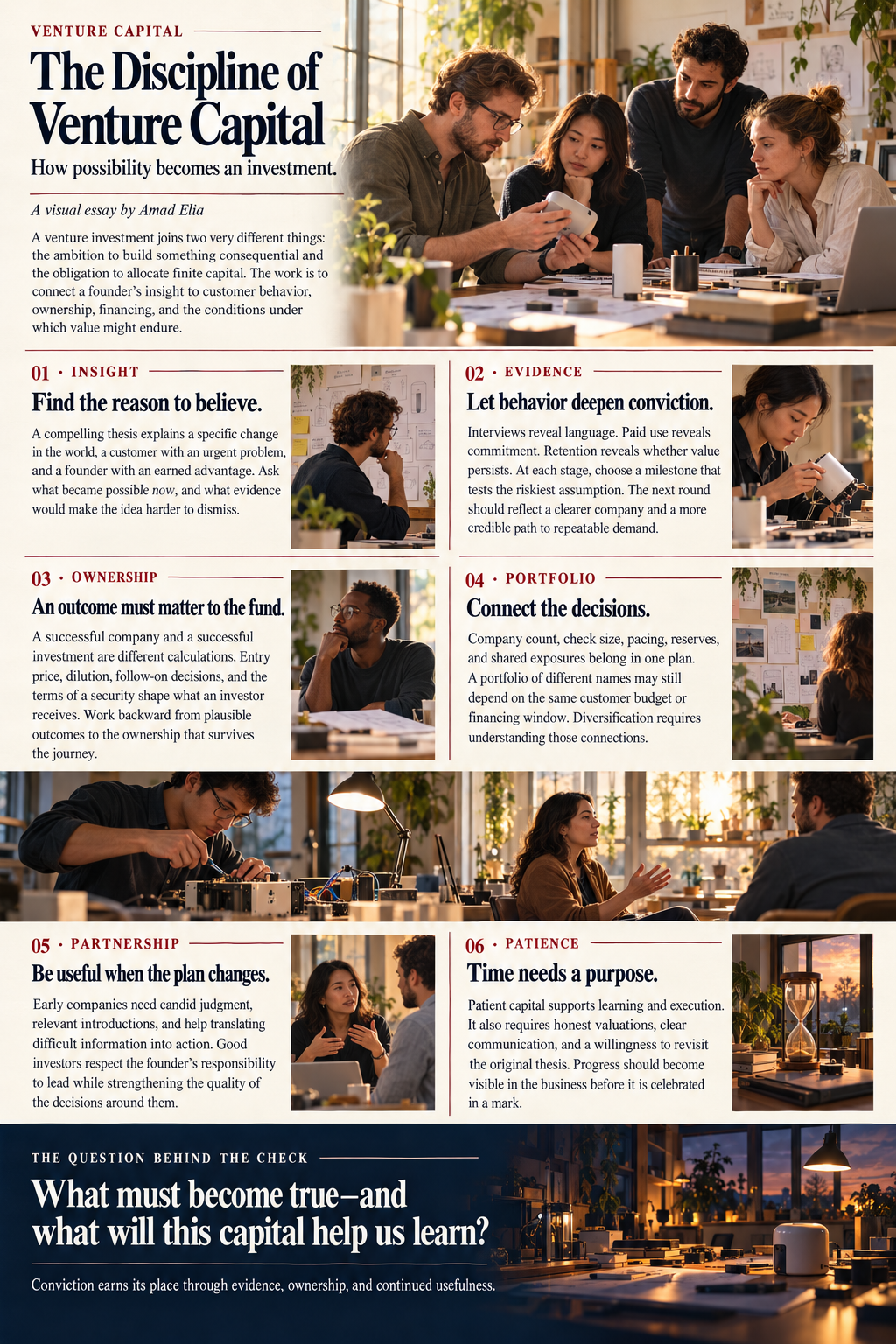
A venture investment joins two very different things: the ambition to build something consequential and the obligation to allocate finite capital. The work is to connect a founder’s insight to customer behavior, ownership, financing, and the conditions under which value might endure.
Find the reason to believe.
A compelling thesis explains a specific change in the world, a customer with an urgent problem, and a founder with an earned advantage. Ask what became possible now, and what evidence would make the idea harder to dismiss.
My starting point is a claim precise enough to investigate. A market label tells me little about who needs the product, who controls the budget, or what has made the existing solution inadequate. The better question is which observation gives this team an unusually useful starting position.[1]
Let behavior deepen conviction.
Interviews reveal language. Paid use reveals commitment. Retention reveals whether value persists. At each stage, choose a milestone that tests the riskiest assumption. The next round should reflect a clearer company and a more credible path to repeatable demand.
The appropriate proof changes with the company. A scientific breakthrough may first require technical validation; an application may need repeat use by a tightly defined customer group. I want the team to name the unresolved question before setting the milestone, so a busy quarter can be distinguished from a useful one.[2]
An outcome must matter to the fund.
A successful company and a successful investment are different calculations. Entry price, dilution, follow-on decisions, and the terms of a security shape what an investor receives. Work backward from plausible outcomes to the ownership that survives the journey.
Ownership belongs in the original decision. A valuation cap on a SAFE is not interchangeable with a priced-round valuation, and later financings can change the percentage ultimately held. The illustration below isolates the arithmetic; an actual distribution also depends on the security, capitalization, and transaction terms.[3]
Connect the decisions.
Company count, check size, pacing, reserves, and shared exposures belong in one plan. A portfolio of different names may still depend on the same customer budget or financing window. Diversification requires understanding those connections.
Venture outcomes can be highly uneven, which makes both access to exceptional companies and exposure to permanent loss relevant. I would rather make the trade-offs explicit than borrow a universal rule about portfolio size or reserves. The design must fit the fund’s actual commitments and capacity to help.[4]
Be useful when the plan changes.
Early companies need candid judgment, relevant introductions, and help translating difficult information into action. Good investors respect the founder’s responsibility to lead while strengthening the quality of the decisions around them.
Usefulness is specific. It might be clarifying a hiring decision, introducing a customer who can challenge the product, or helping a founder evaluate a difficult financing choice. I value a relationship in which unwelcome information can arrive early enough to change a decision.
Time needs a purpose.
Patient capital supports learning and execution. It also requires honest valuations, clear communication, and a willingness to revisit the original thesis. Progress should become visible in the business before it is celebrated in a mark.
A higher paper valuation and cash returned to investors answer different questions. Transparent reporting should explain both progress and uncertainty. Patience is most useful when it gives a team room to do consequential work while keeping everyone accountable for what is actually being learned.[5]
What must become true—and what will this capital help us learn?
Conviction earns its place through evidence, ownership, and continued usefulness.
The questions and investment judgments above are the author’s analysis. These sources provide context and practical frameworks.
- Sequoia Capital · Writing a Business Plan
Customer problems, timing, markets, business models, and the founder’s vision.
- Sequoia Capital · Measuring Product Health
A practitioner framework for engagement and retention; these are signals to interpret in context.
- Y Combinator · The SAFE
Primary documentation for the instrument. The ownership illustration is the author’s hypothetical arithmetic, not a SAFE conversion model.
- Commonfund · The Power Law of Venture Returns
Historical portfolio observations on concentrated outcomes; no historical percentage is presented here as a forecast.
- NVCA · Operating Principles
Diligence, financial controls, valuation, and communication with limited partners.