Read the complete essay as text, with sources
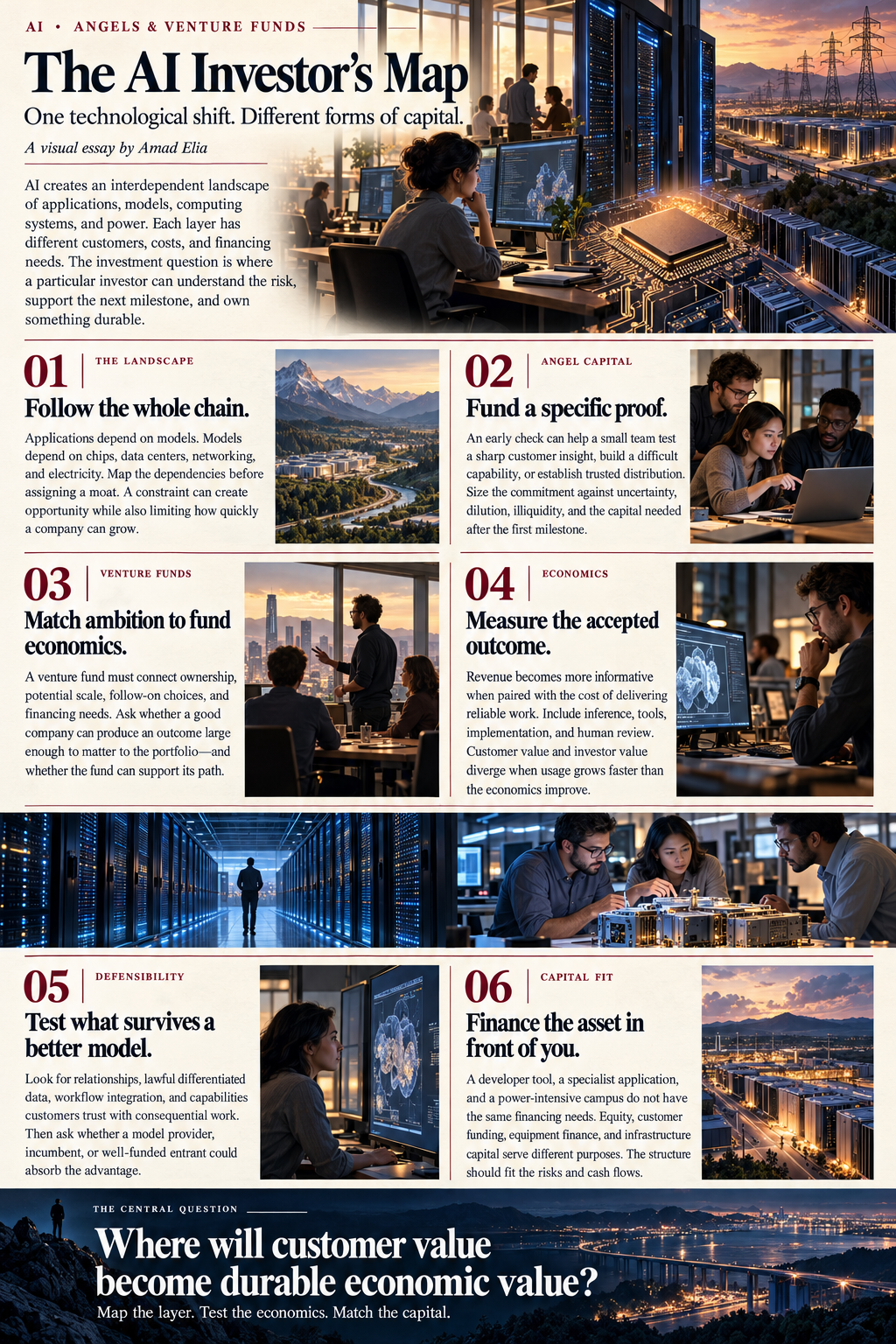
AI creates an interdependent landscape of applications, models, computing systems, and power. Each layer has different customers, costs, and financing needs. The investment question is where a particular investor can understand the risk, support the next milestone, and own something durable.
Follow the whole chain.
Applications depend on models. Models depend on chips, data centers, networking, and electricity. Map the dependencies before assigning a moat. A constraint can create opportunity while also limiting how quickly a company can grow.
Stanford’s 2026 AI Index describes rising investment alongside growing revenue and compute expenditure. Those conditions can support very different businesses. A product team buying model access and a developer financing a data-center campus require different evidence, expertise, and capital structures.[1][2]
Fund a specific proof.
An early check can help a small team test a sharp customer insight, build a difficult capability, or establish trusted distribution. Size the commitment against uncertainty, dilution, illiquidity, and the capital needed after the first milestone.
The question is what becomes knowable before much more money is required. For an application, that might be a repeatable customer workflow and evidence that someone will pay. For a technical company, it could be a meaningful performance threshold. Small initial checks can still lead into businesses with substantial later financing needs.[3]
Match ambition to fund economics.
A venture fund must connect ownership, potential scale, follow-on choices, and financing needs. Ask whether a good company can produce an outcome large enough to matter to the portfolio—and whether the fund can support its path.
The same company can fit one investor’s strategy and strain another’s. Fund size, check size, remaining capital, and the ability to syndicate later rounds change the practical decision. Angels also need to understand dilution and outcomes; the fund lens adds explicit obligations to a pooled portfolio and its limited partners.[4]
Measure the accepted outcome.
Revenue becomes more informative when paired with the cost of delivering reliable work. Include inference, tools, implementation, and human review. Customer value and investor value diverge when usage grows faster than the economics improve.
An accepted outcome is useful because it includes the cost of retries and corrections. A cheap model response that needs repeated checking may be expensive to deliver as a trustworthy service. I would test the economics at realistic usage levels and revisit the model when pricing, architecture, or customer behavior changes.[5]
Test what survives a better model.
Look for relationships, lawful differentiated data, workflow integration, and capabilities customers trust with consequential work. Then ask whether a model provider, incumbent, or well-funded entrant could absorb the advantage.
Workflow ownership is an investment question, not a slogan. I want to know where information enters the system, who acts on its output, and what makes the product difficult to replace. A faster model may strengthen the application, commoditize part of it, or enable a competitor. Each possibility belongs in diligence.[6]
Finance the asset in front of you.
A developer tool, a specialist application, and a power-intensive campus do not have the same financing needs. Equity, customer funding, equipment finance, and infrastructure capital serve different purposes. The structure should fit the risks and cash flows.
The IEA identifies grid connections, supply chains, affordability, and financing among the constraints on data-center development. A large pipeline of proposed projects is not the same as available capacity or contracted demand. For physical infrastructure, site-specific execution and counterparty quality can matter as much as the technology narrative.[7]
Where will customer value become durable economic value?
Map the layer. Test the economics. Match the capital.
The questions and investment judgments above are the author’s analysis. These sources provide context and practical frameworks.
- Stanford HAI · 2026 AI Index: Economy
The funding and cost backdrop. Aggregate investment is context, not evidence that any particular company will succeed.
- Andreessen Horowitz · The Machine Age Fund
A practitioner perspective on chips, systems, and the physical infrastructure behind AI.
- SEC Investor.gov · Private Investments
Risk context for early private investments, including limited information and liquidity. See the source’s current guidance.
- NVCA · Operating Principles
The responsibilities of managers investing on behalf of limited partners.
- Vista Equity Partners · Inference Economics
A practitioner analysis of the costs of operating AI products and the role of architecture in unit economics.
- Andreessen Horowitz · Owning the Workflow in B2B AI Apps
A framework for thinking about workflow integration and customer value, rather than a guarantee of defensibility.
- IEA · Powering Artificial Intelligence
Published October 14, 2026. Infrastructure constraints, electricity-system integration, and local consequences.